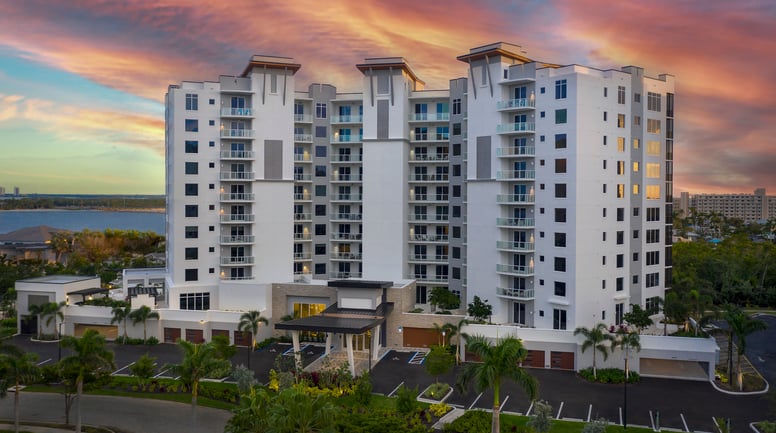
When searching for a luxury condominium, one of the decisions buyers may encounter is whether to choose a high-rise, mid-rise, or low-rise building. While the most obvious difference is the number of stories, each type of condominium offers different considerations when it comes to views, accessibility, privacy, and everyday convenience.
High-rise condos typically offer residences on higher floors, often with expansive views and greater separation from street-level activity. Mid-rise buildings provide a middle ground, while low-rise condos keep residents closer to surrounding grounds and outdoor spaces. Understanding the advantages and potential trade-offs of each can help buyers choose a condominium that fits how they want to live.
What Is the Difference Between a High-Rise, Mid-Rise, and Low-Rise Condo?
High-rise, mid-rise, and low-rise condominiums are generally distinguished by the number of stories in the building. Although classifications can vary by location, the following ranges are commonly used to describe each type.
|
Building Type |
Typical Height |
Key Characteristics |
|
High-Rise Condo |
Often 8 or more stories |
Elevated residences, expansive views, elevator access, and vertical building layouts |
|
Mid-Rise Condo |
Commonly 4–7 stories |
Moderate building height, elevator or stair access, and a balance between elevated and ground-level living |
|
Low-Rise Condo |
Typically 1–3 stories |
Shorter buildings, fewer floors to navigate, and potential for direct entrances or ground-level outdoor spaces |
These ranges are general real estate descriptions rather than universal standards. For example, building codes may define a high-rise based on the height of an occupied floor rather than the number of stories.
Beyond these classifications, differences in building layout, the number of residences, and access to shared spaces can influence what it's like to live in each type of condominium.
What Is It Like to Live in a High-Rise Luxury Condo?
High-rise luxury condos are commonly associated with elevated views, contemporary architecture, and residences positioned above much of the surrounding activity. Depending on their location and design, these buildings can offer views of coastlines, city skylines, or natural landscapes that may not be available from lower floors.
Advantages of High-Rise Condo Living
- Expansive views: Higher floors may offer unobstructed perspectives of surrounding landscapes, particularly in waterfront and urban locations.
- Greater separation from ground-level activity: Elevated residences can provide distance from nearby streets, pedestrian areas, and activity around the property.
- Architectural opportunities: High-rise buildings often incorporate expansive windows, balconies, and terraces that take advantage of their elevation.
- Convenient shared amenities: Depending on the development, fitness centers, lounges, pools, and other amenities may be accessible through the building's elevator system.
What Should Buyers Consider About High-Rise Condos?
Because high-rise living involves more vertical travel, buyers should evaluate the number of elevators, how they are shared, and how easily residents can move between their homes and common areas.
The total number of residences is another consideration. A high-rise with hundreds of homes can have a very different atmosphere from a boutique building with only a few residences per floor.
For example, Grandview at Bay Beach features 58 luxury residences across 11 stories, with private elevator entry and separate owner and service elevators. These features demonstrate how the layout of a high-rise can provide convenient access while maintaining a more intimate residential setting.
What Is It Like to Live in a Mid-Rise Luxury Condo?
Mid-rise luxury condos offer a middle ground between taller residential towers and smaller, low-rise buildings. Typically featuring four to seven stories, they provide opportunities for elevated residences without the full height of a high-rise.
These buildings can be found in urban neighborhoods, residential communities, and waterfront developments. Their design varies considerably, with some featuring shared interior corridors and elevators, while others incorporate outdoor walkways or courtyard-style layouts.
Advantages of Mid-Rise Condo Living
- Moderate elevation: Upper-floor residences may provide attractive views while remaining closer to ground level than those in taller towers.
- Fewer floors to navigate: Residents generally have less vertical distance to travel between their homes and building entrances.
- Variety of layouts: Mid-rise developments can offer balconies, terraces, corner residences, and access to landscaped common areas.
- Flexible building configurations: Their moderate height can accommodate different architectural styles and residential arrangements.
What Should Buyers Consider About Mid-Rise Condos?
Although mid-rise buildings are shorter than high-rises, they do not necessarily contain fewer residences. A wide, seven-story building may accommodate more homeowners than a taller condominium with a smaller footprint.
Buyers should also consider how the building is arranged. Some mid-rise condominiums have shared elevators and interior hallways, while others require residents to walk through outdoor corridors or separate structures to reach amenities.
What Is It Like to Live in a Low-Rise Luxury Condo?
Low-rise luxury condos typically feature one to three stories and offer a residential experience that remains closer to ground level.
These buildings may be arranged as individual structures or as part of a larger condominium development. Some resemble garden-style residences or townhomes, while others feature shared entrances and interior corridors.
Unlike high-rise properties, where elevators are usually central to daily movement, low-rise buildings may offer stair access, shorter elevator trips, or direct entrances, depending on the property's design.
Advantages of Low-Rise Condo Living
- Closer proximity to outdoor spaces: Ground-floor residences may provide convenient access to gardens, courtyards, patios, or landscaped grounds.
- Less vertical travel: With fewer stories, residents may have shorter distances to navigate between their residences and building entrances.
- Potential for direct entrances: Some low-rise developments allow homeowners to enter their residences without passing through a shared lobby or hallway.
- Neighborhood-style settings: Developments arranged across multiple smaller buildings can create a residential atmosphere similar to a traditional neighborhood.
What Should Buyers Consider About Low-Rise Condos?
One of the main considerations is the relationship between the residence and its surroundings. Lower-floor homes may have views limited by nearby landscaping, buildings, or other structures.
Privacy can also vary. Residences located close to shared walkways, courtyards, or parking areas may experience more nearby activity than homes on elevated floors.
Accessibility is another factor to review. Although low-rise buildings have fewer stories, not all offer elevators. Buyers considering an upper-floor residence should confirm how they will access it.
How Do High-Rise, Mid-Rise, and Low-Rise Condos Compare for Everyday Living?
Beyond building height, the most meaningful differences often become apparent when considering everyday activities. Getting to the car, spending time outdoors, receiving guests, or visiting shared amenities can feel different depending on how a building is arranged.
The following comparison highlights common characteristics buyers may encounter.
|
Consideration |
High-Rise |
Mid-Rise |
Low-Rise |
|
Views |
Greater potential for expansive, elevated views |
Views vary by floor and surroundings |
Often closer to landscaping and neighboring structures |
|
Residence access |
Primarily elevators |
Elevators and/or stairs |
Stairs, elevators, or direct entry |
|
Outdoor living |
Elevated balconies and terraces |
Balconies, terraces, or courtyards |
Patios, balconies, or ground-level spaces |
|
Privacy |
May offer more separation from ground-level activity |
Depends on floor location and layout |
Depends on entrances, landscaping, and proximity to shared areas |
|
Parking access |
Often involves elevators and garages |
Varies by building arrangement |
May provide shorter routes or direct access |
|
Community size |
Ranges from boutique towers to large developments |
Varies by building footprint |
Can include multiple buildings and many residences |
These differences are useful starting points, but individual properties may offer features that challenge typical assumptions.
Discover Boutique High-Rise Living at Grandview at Bay Beach
For buyers who appreciate the advantages of high-rise living but prefer a more intimate residential environment, Grandview at Bay Beach offers an appealing combination.
Located on the southern end of Fort Myers Beach, Grandview features just 58 luxury residences within an 11-story building. Private elevator entry, spacious floor plans, and expansive terraces bring together the benefits of an elevated waterfront residence with the privacy of a boutique condominium community.
With views of Estero Bay and the Gulf, Grandview demonstrates how building height, residential scale, and thoughtful design can work together to create a distinctive coastal living experience.
Explore Grandview at Bay Beach to learn more about its luxury waterfront residences and schedule a private tour.
Frequently Asked Questions About High-Rise, Mid-Rise, and Low-Rise Condos
How Many Floors Is Considered a High-Rise Condo?
High-rise condominiums are often described as buildings with eight or more stories, although classifications vary. Under the International Building Code, a high-rise generally has an occupied floor or occupiable roof more than 75 feet above the lowest level of fire department vehicle access.
Are High-Rise Condos More Expensive Than Low-Rise Condos?
Not necessarily. Purchase prices depend on location, residence size, available views, construction quality, amenities, and market demand. A luxury low-rise residence in a highly desirable area may cost more than a high-rise condo in another location.
Do High-Rise Condos Have More Residents Than Low-Rise Condos?
Not always. The number of residents depends on how many individual residences a property contains. A boutique high-rise with a few homes per floor may have fewer residents than a low-rise development spread across multiple buildings.
Are Mid-Rise Condos a Good Alternative to High-Rise Condos?
Mid-rise condos can be a good alternative for buyers who prefer a shorter building but still want an upper-floor residence. They may offer attractive views, balconies, and elevator access, although these features vary by property.
Which Type of Condo Offers the Most Privacy?
No single building type guarantees greater privacy. Factors such as residences per floor, private entrances, elevator access, landscaping, and the location of shared spaces are more reliable indicators of how private a condominium may feel.